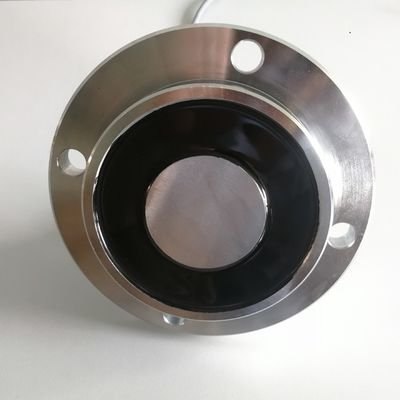
A holding electromagnet is the inverse of a moving-plunger solenoid: the load is the armature. Energised, it attracts and grips a steel surface; the specification that matters is holding force against a stated plate thickness and air gap, because a 0.1 mm gap can halve the grip. Circular pot magnets, rectangular frames and large-area lifting styles all share this physics.
Two sub-types matter. Simple DC holding magnets release the instant the coil is de-energised. Self-holding types add a permanent magnet so the grip survives power loss, released by a short reverse pulse - the KY series here works that way, which is why they suit battery-powered doors, gates and fixtures. Larger round and square holding magnets beyond the catalogue are built to order.
What this specification changes
Gap is the whole specification
Force falls steeply with any non-magnetic gap - paint, scale or an uneven plate. Quote the gap you actually have.
Self-holding changes the power budget
A self-holding magnet grips with zero current and releases on a short reverse pulse - the battery arithmetic flips from continuous to pulse-only.
Residual magnetism is real
Simple DC magnets retain some grip after de-energising; spring-assisted or pulsed release is part of the mechanism design.
Models that meet this specification
| Model | Construction | Stroke | Force | Voltage |
|---|---|---|---|---|
| KY0730L/S | Self-holding KY0730L/S | — | on drawing | to order |
| KY0735L/S | Self-holding KY0735L/S | — | 1.4 k gf | to order |
| KY0940L/S | Self-holding KY0940L/S | — | 2.9 k gf | to order |
| X1010L | Cabinet Lock Solenoid, 5 V | 3 mm | up to 10 N | 5 V DC |
Values are catalogue figures at the stated duty cycle. The force that matters is the force at your working gap — request the curve for the model you shortlist.
Where this specification is used
Questions buyers ask
What is a holding electromagnet?
A solenoid-type magnet that attracts and grips a steel load instead of moving a plunger - rated by holding force at a stated gap and plate.
Does a holding magnet release instantly?
A plain DC holding magnet releases on coil-off with some residual grip; a self-holding type grips through power loss and releases on a reverse pulse.
Can holding magnets be custom sized?
Yes - circular and rectangular bodies beyond the catalogue are built to order around the plate size and force you need.