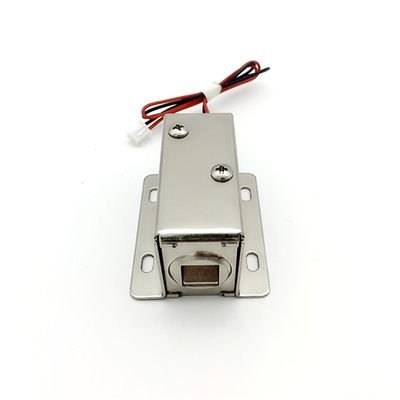
Where this type fits
Solenoid, bolt and housing supplied as one tested assembly — for parcel lockers, vending machines, access control and electronic cabinet locks.
How it works
Current through the coil produces a magnetic field that pulls the plunger into the air gap. The useful output is a force that rises steeply as the gap closes — which is why the rated force always belongs to a specific stroke, not to the part in general. Solenoid designs trade package size against that force profile in a different way from the other families, and the comparison table below reflects that.
Models in this family
| Model | Description | Stroke / orifice | Force / pressure | Voltage |
|---|---|---|---|---|
| X1010L | Cabinet Lock Solenoid, 5 V | 3 mm | up to 10 N | 5 V DC |
What decides the choice
Stroke versus force
Long stroke with high force means a large frame. Fix the stroke first, then see what force is achievable in the space you have.
Duty cycle
Continuous operation needs a coil sized for the temperature rise, not the peak force. Most field failures start here.
Supply and drive
Available voltage, inrush behaviour and whether the drive is a relay, MOSFET or H-bridge all change the coil design.
Environment
Ambient temperature, humidity, dust and vibration determine sealing and insulation class.
What can be customised
- Coil winding: voltage, resistance, power and insulation class
- Stroke and force profile for your mechanism
- Termination: fly leads, PCB pins, connector or terminal block
- Mounting pattern, plunger end form and return spring
- Sealing, encapsulation and acoustic damping
Shop this family by specification
Questions buyers ask us
Who manufactures solenoid locks for parcel lockers?
Chinese manufacturers supply either the bare solenoid or the complete lock assembly — solenoid, bolt and housing tested together. Cixin Industrial supplies both forms; a worked example is the battery-powered parcel locker lock (8 mm bolt throw on a 150 ms pulse). What matters at cabinet level — cycle life per door, open-signal feedback, mechanical release — is covered on the locker and vending application page.
What holding force does a locker lock need?
80 kg to 200 kg holding is the typical range in this catalogue, but the number that matters is holding force against the worst-case shock load — a slammed locker door loads the bolt several times the static force. Specify two to three times the static load and ask for the shock test report.
Should a locker lock be fail-secure or fail-safe?
Most unattended cabinets are fail-secure: locked without power, with a mechanical override for service. Fail-safe (opens on power loss) suits fire-egress doors, not parcel lockers. It is a design decision to state explicitly, not a default.