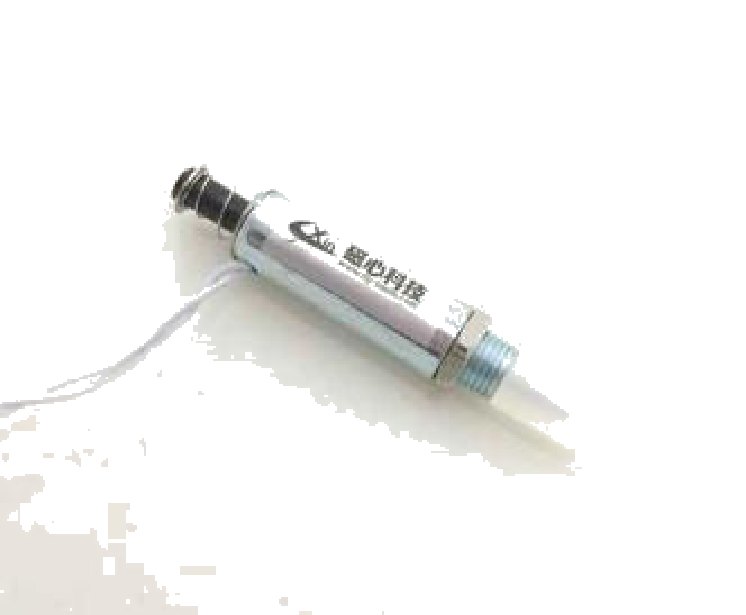
Miniature tubular solenoids trade thermal mass for size. A 9 mm body has very little surface area to shed the heat its coil generates, so the continuous wattage is low — often 1.5 W to 2.5 W — even though the peak force for the size is respectable. Designers who expect a part this small to run continuously at the wattage of a larger frame are usually surprised by how quickly it reaches its limit.
Within that limit, miniature tubular parts are the most efficient way to put linear motion into a small envelope. The round housing closes the flux path, the bore guides the plunger, and the assembly can be potted or sealed. The models below cover 9 mm to 16 mm diameters, with coil data published at four duty cycles so the thermal limit is visible before the drawing is fixed.
What this specification changes
Surface area is the limit
A 9 mm body has roughly a third of the surface of a 16 mm body for a comparable copper loss per unit force. That is why the smallest frames are pulse-rated rather than continuous, and why the duty-cycle ladder matters more here than anywhere else.
The lead exit is a failure point
On a part this small the fly leads are often the weakest element. Specify strain relief, a potted exit or a connector if the assembly will be handled, potted or vibrated.
Bore clearance sets the force spread
Tolerance on the bore and plunger is a larger fraction of the gap on miniature parts, so force varies more between units. If the mechanism is marginal, say so — selective assembly or a tighter bore tolerance is possible.
Mounting distorts a thin wall
Clamping a thin-walled tube out of round adds friction and reduces force. Use a clamp band on a reinforced section, or pot the part into the housing instead of clamping it.
Models that meet this specification
| Model | Construction | Stroke | Force | Voltage |
|---|---|---|---|---|
| T0925L/S | Tubular T0925L/S | — | on drawing | to order |
| T1325L/S | Tubular T1325L/S | — | on drawing | to order |
| T1340L/S | Tubular T1340L/S | — | on drawing | to order |
| T1348L/S | Tubular T1348L/S | — | on drawing | to order |
| T1632L/S | Tubular T1632L/S | — | on drawing | to order |
Values are catalogue figures at the stated duty cycle. The force that matters is the force at your working gap — request the curve for the model you shortlist.
Where this specification is used
Questions buyers ask
How small can a tubular solenoid be?
Nine millimetres body diameter is the smallest in the standard range. Smaller diameters can be wound and machined to order, but force falls quickly with size and the tooling cost has to be justified by volume.
Can a miniature solenoid run continuously?
Only at the 100 % ED wattage, typically 1.5 W to 2.5 W on these frames. Above that, reduce the duty cycle or improve the heat path by potting into a metal housing.
Is 24 V available in a miniature frame?
Yes, as a winding choice. The extra turns mean finer wire and less copper in the same window, so the achievable wattage at 24 V is lower than at 12 V on the same frame.
How loud is it?
There is an audible click at impact. An elastomer stop or a damped plunger reduces it, at the cost of a little stroke and a few milliseconds of response time.