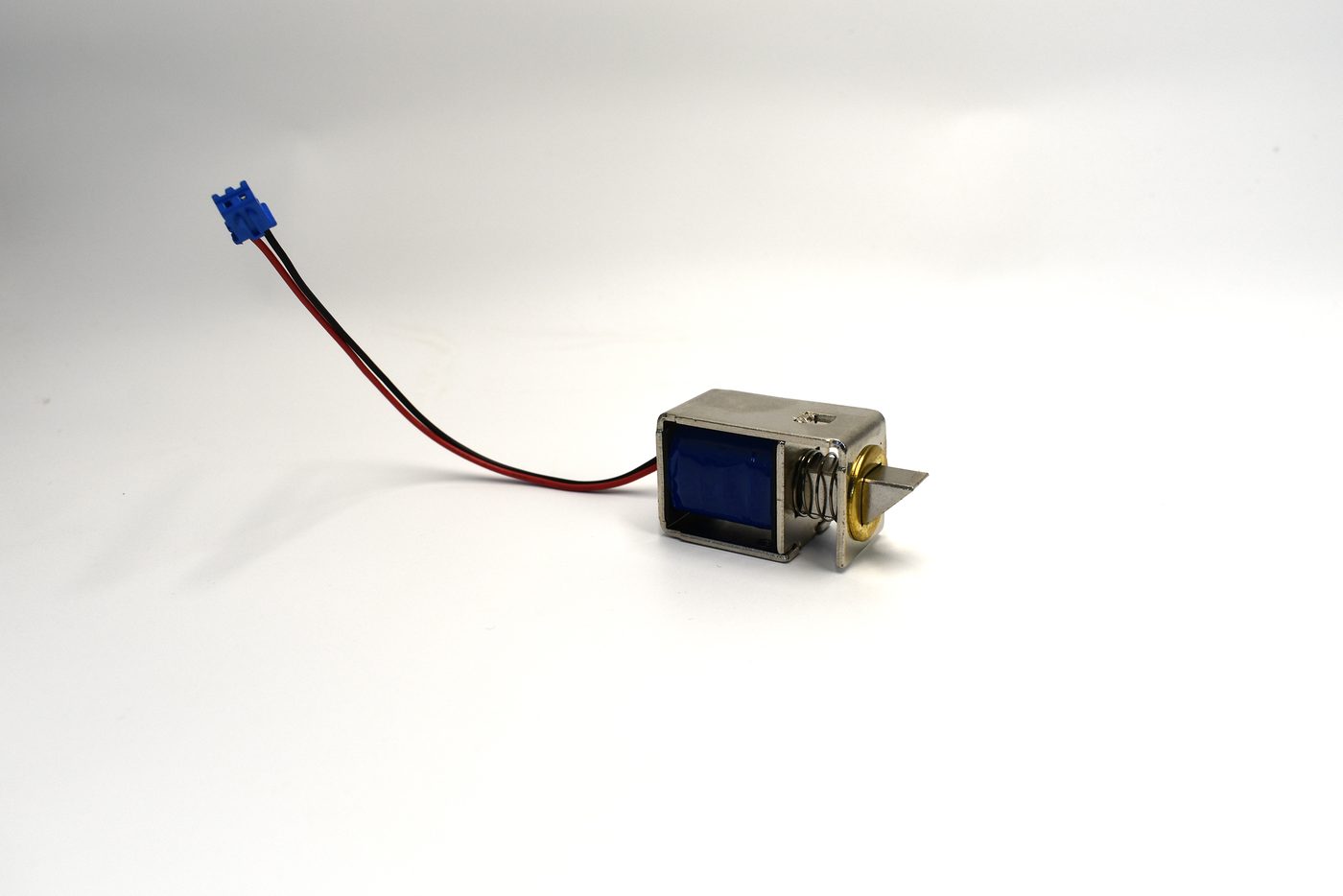
A push-pull solenoid converts coil current into a short linear stroke. The frame is built in two versions: the L version pulls the plunger into the coil when energised, the S version pushes it out. Direction is fixed mechanically, so the first specification question is always which way the load moves - and whether a spring does the return.
The type covers open-frame rectangular parts, sealed versions for outdoor use, and long-stroke variants. What they share is the simplest drive in the actuator world: one direction, one coil, one MOSFET or relay.
What this specification changes
Read force at the stroke, not at zero gap
The catalogue force is a closed-gap figure. The number that moves your bolt is the force at the end of the stroke - often a third of the headline.
Open frame or sealed
Open frames dissipate heat well and cost less; sealed parts (IP54) survive outdoor and automotive duty at some continuous-wattage cost.
The spring is half the design
Return spring rate sets reset speed and subtracts force across the whole stroke. Send the spring data with the enquiry.
Models that meet this specification
| Model | Construction | Stroke | Force | Voltage |
|---|---|---|---|---|
| U0835L-12C13 | Rectangular Push-Pull Solenoid | up to 8 mm | up to 30 N | 12 V DC |
| U1253L/S | Compact Open-Frame Push-Pull Solenoid | up to 10 mm (curve range) | on drawing | Custom at order (typ. 12 / 24 V DC) |
| U0876 | Automotive Push-Pull Solenoid | 6 mm | up to 8 N | 12 V DC |
| U30120L/S | Open-frame U30120L/S | — | on drawing | to order |
Values are catalogue figures at the stated duty cycle. The force that matters is the force at your working gap — request the curve for the model you shortlist.
Where this specification is used
Questions buyers ask
What is a push pull solenoid?
A linear solenoid built as a pull (L) or push (S) version: energise the coil and the plunger moves in one direction; a spring or the mechanism returns it. The suffix in the part number is the direction.
Can a push pull solenoid do both directions?
Not on command - the direction is set by the plunger end and stop. Two directions need two coils, a latching type, or a spring doing one direction.
What voltages are available?
The same frames are wound for 6, 12 or 24 V DC; the winding changes the current and the wattage ladder, not the mechanics.