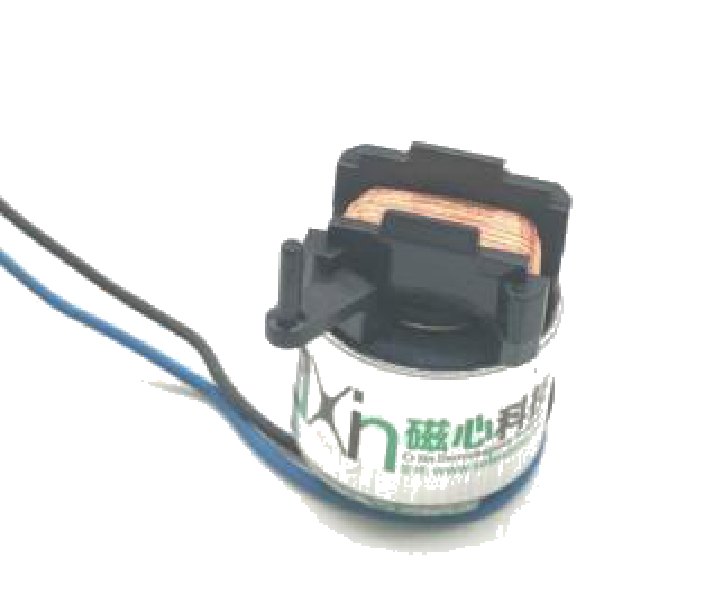
A rotary solenoid converts coil energy into a short angular step, usually 25° to 95°, as the armature is pulled into a shaped air gap. The time to complete that step depends on the inertia of the armature plus whatever it drives, and on how fast the coil can build current. Both point the same way: a small, low-inertia rotor with a short step is faster than a large one driven harder.
In practice the fast parts in this range are the small frames. A 12 mm body with a 0.06 W coil completes its rotation in a few milliseconds; a 32 mm frame at 19 W is built for torque, not speed. Choosing between them is a question of what the load needs — an optical shutter needs almost no torque and maximum speed, while a sorting gate has to move a mass and can afford 30 ms.
What this specification changes
Inertia dominates the time
Doubling the inertia of the load roughly doubles the time to rotate at the same torque. If the mechanism can be made lighter or the mass moved closer to the axis, that buys more speed than a larger coil.
The stop takes the impact
A fast rotary part hits its end stop hard. The stop, not the solenoid, absorbs that energy. A resilient stop cuts noise and wear but adds a few milliseconds; a hard stop is faster and noisier.
Spring return costs speed both ways
A return spring adds torque against the drive on the way out and sets the reset time. A detent or a magnetic bistable return is faster where the application allows it.
Match the driver to the coil
A 0.06 W coil has high resistance and a small current; a 48 W coil needs a driver sized for 2 A at 24 V. Neither tolerates the wrong driver, and both need suppression across the coil.
Models that meet this specification
| Model | Construction | Stroke | Force | Voltage |
|---|---|---|---|---|
| SW1215L | Rotary SW1215L | — | on drawing | to order |
| XZ2525L | Rotary XZ2525L | — | on drawing | to order |
| SW3235L | Rotary SW3235L | — | on drawing | to order |
| XZ2661L | Rotary XZ2661L | — | on drawing | to order |
| XZ8656L | Rotary XZ8656L | — | on drawing | to order |
Values are catalogue figures at the stated duty cycle. The force that matters is the force at your working gap — request the curve for the model you shortlist.
Where this specification is used
Questions buyers ask
How fast can a rotary solenoid actuate?
A few milliseconds for the smallest frames at rated voltage, and roughly 20 ms to 50 ms for the larger torque frames. The figure depends on load inertia, so it has to be measured rather than assumed.
Can it stay energised in the rotated position?
Only within the maximum ON time, which is 1 s to 5 s depending on frame. Continuous holding needs a latching or detent type rather than a standard spring-return rotary.
Is the rotation angle adjustable?
The step is set by the pole geometry. A mechanical stop can trim it by a few degrees, but a different angle means a different part.
Can it rotate in both directions?
Standard parts are single-direction with spring return. Bi-directional motion needs two coils or a reversing drive, and is a custom build.