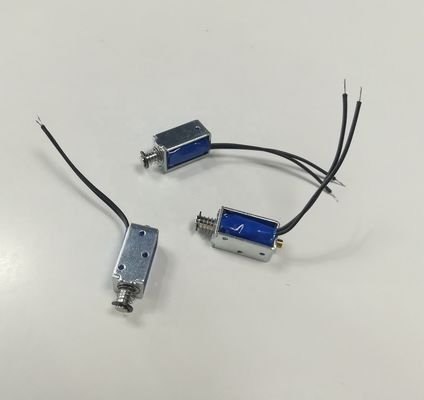
Every solenoid's continuous wattage is limited by how fast it can shed heat. A low power design accepts that limit and works with it: the coil is wound for a small continuous wattage, and the mechanism is arranged so that full force is needed only briefly. The result is a part that can run from a battery or a 4–20 mA loop, provided the pulse is short and the capacitor is large enough.
Two structures make this practical. A latching solenoid removes the holding current entirely, so average power is pulse energy divided by the interval between operations. A spring-return part at 0.6 W to 1.5 W is simpler, but it has to stay energised while the mechanism is held. Choose the first where the hold is long, the second where the hold is short and the drive must stay simple.
What this specification changes
Battery life is arithmetic
A 12 V, 10 W pulse of 100 ms uses 1 J. At one operation an hour that is about 0.28 mWh per cycle, small next to a coin cell's capacity — but a hundred operations an hour changes the answer completely.
The capacitor does the work
A small cell cannot deliver 1 A without a voltage sag. A 470 µF to 2200 µF capacitor at the coil terminals supplies the pulse and lets the battery see a much smaller average current.
Low wattage means fine wire
A 0.6 W coil at 12 V draws 50 mA through a fine gauge winding. Handling, termination and vibration resistance become the design issues rather than heat.
Sleep current decides the shelf life
A latching part with a leakage path through the driver can drain a battery faster than the actuation. Check the off-state current of the whole circuit, not just the coil.
Models that meet this specification
| Model | Construction | Stroke | Force | Voltage |
|---|---|---|---|---|
| SW1215L | Rotary SW1215L | — | on drawing | to order |
| U0421L/S | Open-frame U0421L/S | — | on drawing | to order |
| U0415L/S | Open-frame U0415L/S | — | on drawing | to order |
| X1010L | Cabinet Lock Solenoid, 5 V | 3 mm | up to 10 N | 5 V DC |
| KS1225L/S | Bi-stable latching KS1225L/S | — | 200 gf | to order |
Values are catalogue figures at the stated duty cycle. The force that matters is the force at your working gap — request the curve for the model you shortlist.
Where this specification is used
Questions buyers ask
What is the lowest power solenoid available?
0.06 W continuous on the SW1215L miniature rotary frame. For linear motion, 0.6 W on the U0421L/S open-frame part, with 5 W and below covered by several other frames.
Can I run a solenoid from a coin cell?
Only with a capacitor and a short pulse. The cell's internal resistance limits peak current, so the capacitor supplies the pulse and the cell recharges it between operations.
Is a low power solenoid weaker?
At the same size and continuous rating, yes. But a pulsed low-power part can match a larger continuous part for a short stroke, because force depends on ampere-turns, not on continuous wattage.
Is 5 V available?
Yes. The X1010L cabinet lock runs on 5 V DC, and other frames can be wound for 5 V within the limits of the winding window.