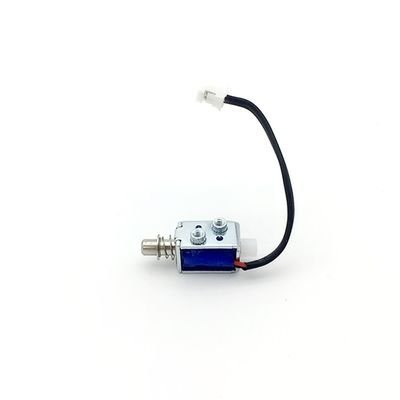
A cabinet lock differs from a door lock in three ways that change the part. The rail is shared: 12 V or 24 V industrial, sometimes 5 V logic-side, so the coil must pull in at the worst-case voltage at the end of the harness. The space is tight: compact bolt mechanisms, often with the solenoid and latch integrated into one small housing. And the controller wants to know it worked: an open signal confirming the bolt actually moved, because a service technician who cannot tell failed actuation from a full compartment will force the door.
The X1010L is the catalogue reference - a compact cabinet lock solenoid running on 5 V DC. For cabinets that need battery autonomy or fail-secure behaviour, the lock is built around a latching mechanism with a mechanical override planned in from the start.
What this specification changes
Voltage at the far end decides
Shared rails sag. Specify pull-in at the worst-case end-of-harness voltage and the coil is wound for it.
Feedback prevents forced doors
An open signal on the same connector as the coil costs little and saves doors - technicians who cannot confirm actuation force them.
Space dictates integration
Compact envelopes usually mean the solenoid and latch are engineered together - send the housing, not just the bolt spec.
Models that meet this specification
| Model | Construction | Stroke | Force | Voltage |
|---|---|---|---|---|
| X1010L | Cabinet Lock Solenoid, 5 V | 3 mm | up to 10 N | 5 V DC |
| KS1225L/S | Bi-stable latching KS1225L/S | — | 200 gf | to order |
Values are catalogue figures at the stated duty cycle. The force that matters is the force at your working gap — request the curve for the model you shortlist.
Where this specification is used
Questions buyers ask
What voltage does a cabinet lock solenoid use?
Whatever the rail is - the X1010L runs on 5 V DC and other builds are wound for 12 or 24 V, rated at the worst-case voltage at the end of the harness.
Should a cabinet lock be fail-secure?
For unattended equipment, yes - locked without power, with a mechanical override for service. Fail-safe suits fire-egress doors, not cabinets.
Can the lock report open status?
Yes - a reed or optical open signal integrated into the assembly confirms the bolt moved. It belongs on the same connector as the coil.