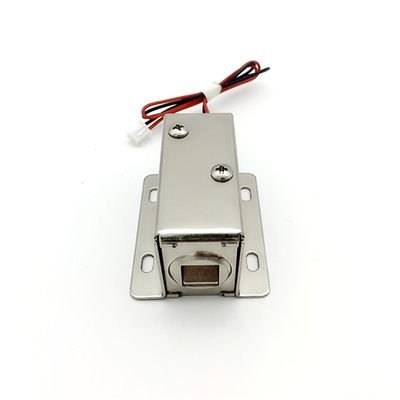
A solenoid door lock is either a bare solenoid that drives the bolt, or the complete assembly - solenoid, bolt and housing qualified together. The first suits an established mechanism; the second removes the tolerance stack that appears when a catalogue solenoid drops into someone else's housing. We supply both forms.
For battery-powered doors the default construction is a latching solenoid: a short pulse moves the bolt and a permanent magnet holds the state with zero current. Spring-return suits mains-powered or frequently cycled doors. Either way the numbers that decide the part are bolt travel, force at the working gap, the shock load of a slammed door and the noise limit at the coldest morning the door will see.
What this specification changes
Latching owns battery doors
Zero holding current turns weeks of battery life into a year; spring-return only wins on mains power or very high cycle rates.
Noise is a designed property
A resilient stop, damped plunger and matched spring rate cut the click - proven under 50 dB at -40 C in a shipped automotive lock programme.
Assembly or component changes the test
A tested lock assembly ships with cycle and shock data for the whole mechanism; a bare solenoid leaves the integration testing to you.
Models that meet this specification
| Model | Construction | Stroke | Force | Voltage |
|---|---|---|---|---|
| X1010L | Cabinet Lock Solenoid, 5 V | 3 mm | up to 10 N | 5 V DC |
| KS1225L/S | Bi-stable latching KS1225L/S | — | 200 gf | to order |
| KS1139L/S | Bi-Directional Latching Solenoid | 5 mm curve range | 0.5 kgf | to order |
Values are catalogue figures at the stated duty cycle. The force that matters is the force at your working gap — request the curve for the model you shortlist.
Where this specification is used
Questions buyers ask
What is a solenoid door lock?
A lock whose bolt is driven by a solenoid - supplied as the bare actuator or as a complete tested assembly of solenoid, bolt and housing.
How much force does a door lock solenoid need?
Enough to seat the bolt against spring preload at the end of the stroke - typically 5-40 N at the working gap - with holding or latch force two to three times the slammed-door shock load.
Can it work on battery power?
Yes, as a latching build: the pulse moves the bolt, the magnet holds it, holding current is zero. The battery only supplies pulses.