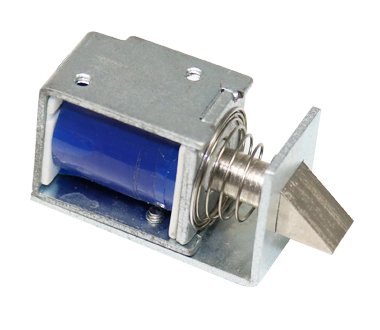
A custom solenoid is specified by your mechanism, not by a catalogue page: the load, the stroke, the force at that stroke, the cycle rate and the environment. From those five answers the construction follows - and in most cases the magnetic circuit stays a proven frame while the winding, plunger end form, return spring, mounting and termination are engineered to fit.
That middle path is the default answer because it pays on every axis: prototypes in days on a machined standard frame, trivial tooling, and risk confined to the parts that actually changed. Full-custom housings and circuits are quoted where the envelope genuinely demands them - with the schedule and the single-source caveats stated, and the full document set released to you.
What this specification changes
Modified frame first
A first article on a modified standard frame keeps the proven circuit and collapses the schedule; full tooling follows only when the design is stable.
Five answers start the design
Load, stroke, force at that stroke, cycle rate, environment. Without them any quotation is a guess with a price.
Own the documentation
Keep drawings, test reports and acceptance criteria in your files; we release the full set on custom projects for exactly this reason.
Models that meet this specification
| Model | Construction | Stroke | Force | Voltage |
|---|---|---|---|---|
| U1253L/S | Compact Open-Frame Push-Pull Solenoid | up to 10 mm (curve range) | on drawing | Custom at order (typ. 12 / 24 V DC) |
| T2530L/S | 25 mm Tubular Solenoid, 30 mm Body | 0–12 mm (curve range) | on drawing | to order |
| X40180 | Square Latching Solenoid | 4 mm | up to 40 N | 6 / 12 V DC |
| U2244L/S | Open-frame U2244L/S | — | on drawing | to order |
Values are catalogue figures at the stated duty cycle. The force that matters is the force at your working gap — request the curve for the model you shortlist.
Where this specification is used
Questions buyers ask
What is the minimum order for a custom solenoid?
Prototypes from a single piece on a modified frame; production is quoted per project with the tooling and break points stated.
What does a custom quotation need?
A 2D drawing or STEP model of the envelope and load, the supply voltage and current available, the cycle profile, and the environment.
Can you match an existing solenoid?
Yes, from a sample or drawing, provided the design is not third-party patented or customer-exclusive - and we will say so if it is.