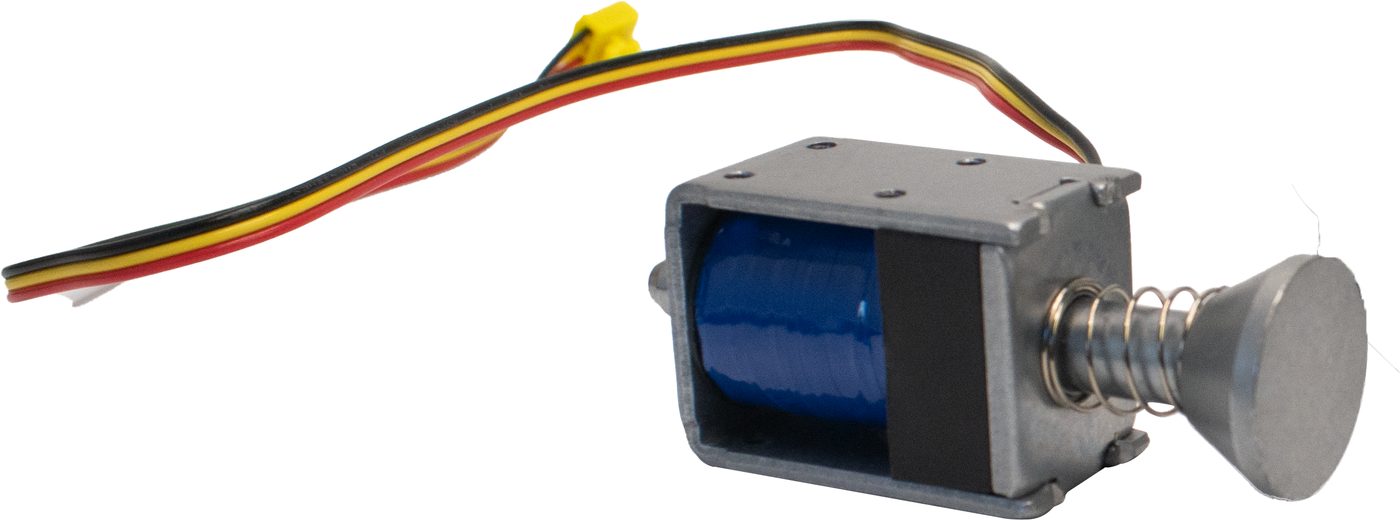
A DC electromagnet is the broad class: a coil and a magnetic circuit doing useful work from a direct-current supply. In this catalogue the class splits three ways by duty. A holding magnet grips a steel load continuously while energised. A self-holding magnet grips through power loss and releases on a reverse pulse. A latching actuator moves a plunger between magnet-held positions. Same physics, three different mechanisms - and choosing the wrong one costs a redesign, not a winding.
All three are wound for the supply you have, 5 to 48 V DC, and all three publish their numbers with conditions: holding force at a stated gap for magnets, force at a stated stroke for actuators. The catalogue frames cover the common sizes; larger bodies are built to order.
What this specification changes
Hold, release or move
Continuous grip = holding magnet; grip through power loss = self-holding; position switching = latching actuator. The constructions differ mechanically.
Suppression is not optional
Every DC coil switched by a semiconductor needs a flyback path; sizing it is part of the circuit, not an afterthought.
Force needs conditions
A holding figure without a gap, or a pull figure without a stroke, is not data. Ask for the number at your geometry.
Models that meet this specification
| Model | Construction | Stroke | Force | Voltage |
|---|---|---|---|---|
| KY0951L/S | Self-holding KY0951L/S | — | 2.9 k gf | to order |
| KY1037L/S | Self-holding KY1037L/S | — | 5 k gf | to order |
| KS1225L/S | Bi-stable latching KS1225L/S | — | 200 gf | to order |
| X1010L | Cabinet Lock Solenoid, 5 V | 3 mm | up to 10 N | 5 V DC |
Values are catalogue figures at the stated duty cycle. The force that matters is the force at your working gap — request the curve for the model you shortlist.
Where this specification is used
Questions buyers ask
What is a DC electromagnet?
A coil-and-core magnet run on direct current - covering holding magnets, self-holding magnets and latching actuators in this catalogue.
DC or AC electromagnet?
DC for steady force, simple drive and battery compatibility; AC frames with laminated stacks only where the supply is inherently AC.
What data comes with a DC electromagnet?
Force at a stated gap (holding types) or stroke (actuators), coil resistance with its measurement temperature, and the duty-cycle rating of the winding.