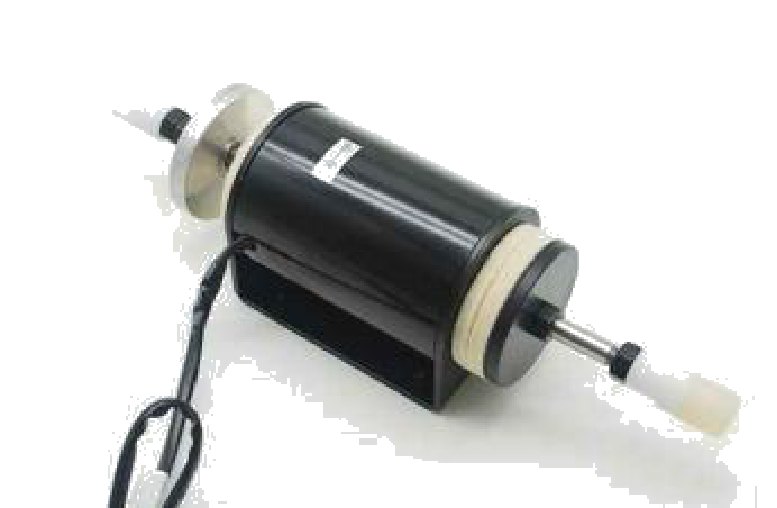
High force is a relative term that becomes exact only when a second number is attached: the air gap at which the force is available. Magnetic force rises steeply as the gap closes, so a part rated 500 N at the closed position may produce a fraction of that at 8 mm. When a brief asks for a high force solenoid, the first useful question is where the load actually sits.
Two frame types carry this range. Large tubular solenoids use a cylindrical housing and a closed magnetic circuit, giving the highest force per unit volume at strokes up to about 12 mm. Large open-frame push-pull units offer more stroke and easier mounting at a lower force density. Both reach the range by adding ampere-turns and iron cross-section — which means copper, weight and heat.
What this specification changes
Force scales with volume, not just copper
Doubling the force at the same stroke needs roughly twice the pole area and twice the ampere-turns. That is why a 500 N part is not a 250 N part with a hotter coil — it is a bigger frame, and the drawing shows it.
The supply sets the peak
The T5892L/S draws 46.5 W continuously and 465 W at 10 % ED. A 50 W bench supply will not deliver that pulse; a supply sized for peak current, or a capacitor bank, will.
Impact loads are not in the catalogue
A high force part stopping a mass at speed sees a shock load several times the static force. The mounting bosses and the plunger thread usually fail before the coil does.
Heat is the real ceiling
At 465 W the coil reaches its insulation limit in seconds. Duty cycle, ambient temperature and whether the part is in free air or enclosed decide survival — the force figure alone does not.
Models that meet this specification
| Model | Construction | Stroke | Force | Voltage |
|---|---|---|---|---|
| T6490L/S | 64 mm Tubular Solenoid, 90 mm Body | 0–12 mm (curve range) | on drawing | to order |
| T5892L/S | Tubular T5892L/S | — | on drawing | to order |
| T6025S | Tubular T6025S | — | on drawing | to order |
| U30120L/S | Open-frame U30120L/S | — | on drawing | to order |
| U2244L/S | Open-frame U2244L/S | — | on drawing | to order |
Values are catalogue figures at the stated duty cycle. The force that matters is the force at your working gap — request the curve for the model you shortlist.
Where this specification is used
Questions buyers ask
What is the highest force you can supply?
500 N at the working gap on 64 mm tubular frames. Above that a different actuator class — hydraulic, pneumatic or a geared motor — is usually the better engineering answer, and we will say so.
Can I overdrive a smaller solenoid for a short pulse?
Within the published duty-cycle ladder, yes. The insulation class sets the ceiling, so ask for the pulse rating at your ambient temperature rather than extrapolating.
Why does my 500 N solenoid only lift 150 N?
Either the load sits at a larger air gap than the rating point, or the supply sags under inrush. Measure the voltage at the coil terminals during the pulse before changing the part.
Does a high force solenoid need its own power supply?
Usually yes. A 465 W pulse at 24 V draws about 19 A. Sharing a supply with logic electronics without decoupling will reset the electronics on every actuation.