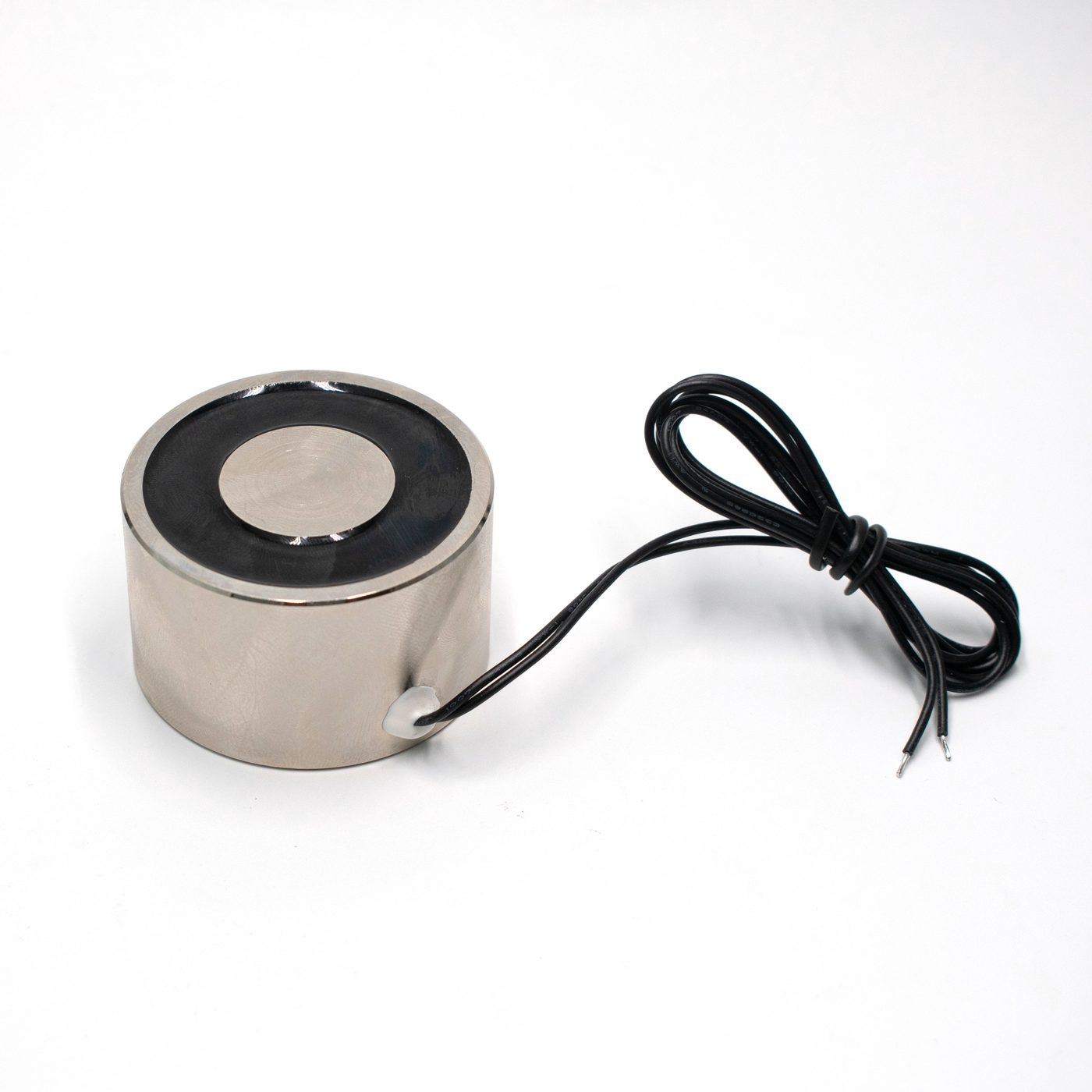
An electric lifting magnet grips ferrous parts for handling - sheet metal, fixtures, doors, robot end-effectors. Unlike catalogue solenoids, lifting duty is specified per load case: the magnet is sized around the plate area, thickness, surface condition and the shock load of handling, with a safety factor agreed in writing rather than assumed. That is why this page describes the capability rather than a fixed model list.
The engineering that decides success: force against the real gap (paint and scale cost grip), coil duty against the cycle rate, release behaviour (simple coil-off, or self-holding with reverse-pulse release where power loss must not drop the load), and the mechanical interface. Send the load case - weight, surface, cycle, safety factor - and the build starts from there.
What this specification changes
The load case is the specification
Plate area, thickness, surface and shock load decide the magnet - a catalogue figure against a perfect plate is not a lifting rating.
Power-loss behaviour is a safety decision
A plain magnet drops on coil-off; a self-holding build grips through power failure and releases on a reverse pulse. Choose deliberately.
Duty and thermal are part of the build
Handling cycles heat the coil; the winding is rated for your cycle rate at your ambient, with the test to show it.
Models that meet this specification
| Model | Construction | Stroke | Force | Voltage |
|---|---|---|---|---|
| KY1037L/S | Self-holding KY1037L/S | — | 5 k gf | to order |
| KY0951L/S | Self-holding KY0951L/S | — | 2.9 k gf | to order |
Values are catalogue figures at the stated duty cycle. The force that matters is the force at your working gap — request the curve for the model you shortlist.
Where this specification is used
Questions buyers ask
Do you stock electric lifting magnets?
The catalogue covers holding and self-holding frames; lifting builds are engineered per load case. Send the weight, surface, cycle and safety factor for a proposal.
What safety factor should a lifting magnet have?
Agreed in the specification, typically well above the static load because of shock and surface variation. The number belongs in the purchase order, not the conversation.
Can the magnet hold through a power cut?
Yes, as a self-holding build - it grips with the permanent magnet and releases on a reverse pulse. Plain coil-off release drops the load by design.