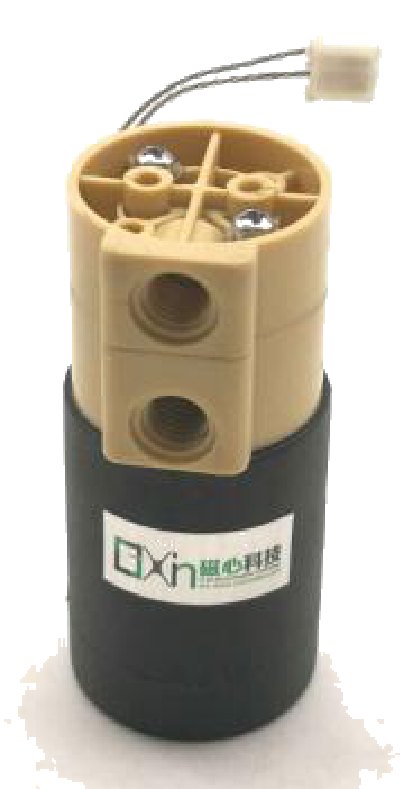
A solenoid valve opens or closes an orifice when its coil energises: two-way for simple on-off, three-way for directing flow between ports. In this catalogue the range is miniature - 0.8 to 3.0 mm orifices at up to 8 bar - for analytical instruments, dosing systems, medical devices and small pneumatic duty. Bodies are PA66 or brass; the seal material follows the medium.
The specification that matters is the medium's: a valve rated for air will not survive a dosing chemical, and a valve rated for water may swell shut in oils. Cycle life is published as 200,000 cycles on the catalogue parts, but the number that deserves design trust is a cycle test on your medium at your pressure - which we run and supply with the sample.
What this specification changes
The medium decides the seal
Elastomer compatibility is the whole valve story: the same construction seals water and dies in solvents. Specify the fluid first.
Orifice is a flow decision
Orifice diameter sets flow at your pressure - bigger is not better if the valve then needs more coil power to close against the load.
Cycle life needs your medium
The 200,000-cycle catalogue figure was measured on a reference fluid; a test on yours is the number the design should trust.
Models that meet this specification
| Model | Construction | Stroke | Force | Voltage |
|---|---|---|---|---|
| QF0421 | Solenoid valve QF0421 | — | on drawing | to order |
| QF2548 | Gas & Liquid Release Solenoid Valve | — | on drawing | to order |
| QF2660 | Solenoid valve QF2660 | — | on drawing | to order |
| QF4675L | Solenoid valve QF4675L | — | on drawing | to order |
Values are catalogue figures at the stated duty cycle. The force that matters is the force at your working gap — request the curve for the model you shortlist.
Where this specification is used
Questions buyers ask
What is a solenoid valve?
A valve opened or closed by a solenoid coil - two-way for on-off, three-way for switching flow between ports. This catalogue covers miniature sizes for instruments and dosing.
What sizes are available?
0.8-3.0 mm orifices at up to 8 bar, two- and three-way, PA66 or brass bodies with seals matched to the medium.
How long does a miniature solenoid valve last?
200,000 cycles as the catalogue figure on a reference fluid; real life depends on medium, pressure and cleanliness, so we cycle-test on your fluid.