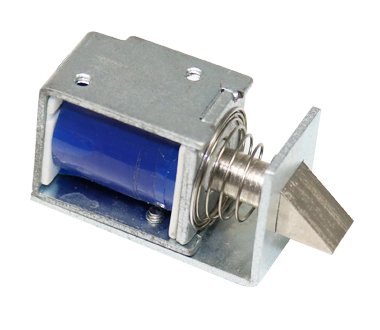
A custom electromagnetic actuator is the assembly-level version of a custom solenoid: the coil and magnetic circuit plus the plunger end form, return spring, guide or bearing, stop, termination and - where the machine needs it - a position switch. Supplying them as one tested assembly removes the tolerance stack that appears when a catalogue solenoid is integrated into a housing designed elsewhere.
The term covers linear actuators (push, pull, latching), holding actuators that grip, and rotary actuators for short angular steps. What they share is the starting point: the mechanism. Load, stroke, force at that stroke, cycle rate and environment decide the construction - and a prototype on a modified proven frame is usually the fastest route to a validated design.
What this specification changes
The assembly is the deliverable
Integration tolerances cause more field failures than coils do; delivering solenoid, spring and guide as one tested unit removes the stack.
Consistency needs a window
Force spread between units comes from gap tolerance, spring rate and coil resistance. Define the acceptance window and test at the point that matters.
Prototype on proven circuits
Modified standard frames keep the magnetic design proven while the interface is engineered - the schedule collapses and the risk stays where you changed things.
Models that meet this specification
| Model | Construction | Stroke | Force | Voltage |
|---|---|---|---|---|
| U1253L/S | Compact Open-Frame Push-Pull Solenoid | up to 10 mm (curve range) | on drawing | Custom at order (typ. 12 / 24 V DC) |
| KS1139L/S | Bi-Directional Latching Solenoid | 5 mm curve range | 0.5 kgf | to order |
| T2530L/S | 25 mm Tubular Solenoid, 30 mm Body | 0–12 mm (curve range) | on drawing | to order |
| X40180 | Square Latching Solenoid | 4 mm | up to 40 N | 6 / 12 V DC |
Values are catalogue figures at the stated duty cycle. The force that matters is the force at your working gap — request the curve for the model you shortlist.
Where this specification is used
Questions buyers ask
What is a custom electromagnetic actuator?
A solenoid integrated with its plunger end, spring, guide, stop and termination into one tested assembly - linear, holding or rotary - built to your mechanism.
How is it different from a custom solenoid?
The solenoid is one component; the actuator is the assembly including the mechanical interface. Most projects start as a custom solenoid and become an actuator once the housing is fixed.
What should I send to start?
A STEP model of the envelope and load, the five duty answers (load, stroke, force, cycle, environment), and the acceptance window the mechanism needs.