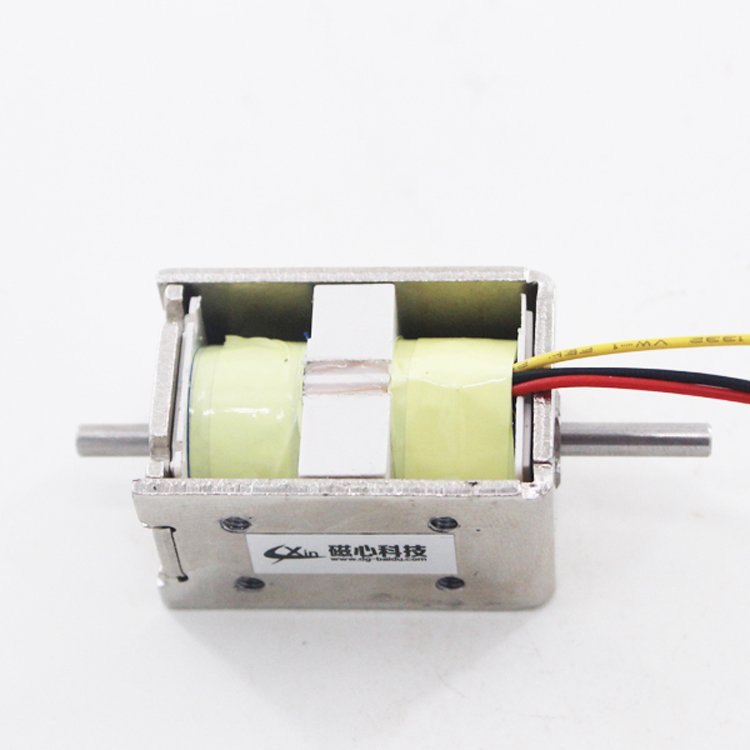
A double latching solenoid - sometimes called double-holding - keeps the plunger magnetically held at both ends of its travel. Energising with one polarity pulls it in; reversing the polarity pushes it out and the magnet holds it there. Both states cost zero holding current, and the coil only exists during the switching pulse.
This is the construction behind two-way electronic locks, water valve latching and battery meters that must fail in a known position. It needs a polarity-reversing drive - an H-bridge or two relay contacts - and a mechanical release for power-off service in most lock applications. The KS1139 is the reference frame here, with siblings across the KS/KY series at different forces and strokes.
What this specification changes
One coil does both states
Unlike a spring-return latching part, no mechanical bias decides the reset - polarity does. That halves the coil count and removes the spring's force penalty.
The drive is the cost
An H-bridge (four switches) or two SPDT relays is mandatory. A single-MOSFET circuit cannot reverse polarity and cannot operate this type.
Failure position must be designed
With no spring, power loss leaves the part wherever it was. Locks therefore pair it with a mechanical override or choose the de-energised state deliberately.
Models that meet this specification
| Model | Construction | Stroke | Force | Voltage |
|---|---|---|---|---|
| KS1139L/S | Bi-Directional Latching Solenoid | 5 mm curve range | 0.5 kgf | to order |
| KS1225L/S | Bi-stable latching KS1225L/S | — | 200 gf | to order |
| KS1564L/S | Bi-stable latching KS1564L/S | — | 1 k gf | to order |
Values are catalogue figures at the stated duty cycle. The force that matters is the force at your working gap — request the curve for the model you shortlist.
Where this specification is used
Questions buyers ask
What is a double latching solenoid?
A bi-stable solenoid magnetically held in both end positions, switched between them by pulse polarity. Holding current is zero in both states.
How is it driven?
By reversing the coil polarity - an H-bridge or two relay contacts. A single-polarity circuit will move it one way only.
What happens on power loss?
It stays where it was - the magnet holds. That is a feature in meters and valves, and a design decision in locks, where a mechanical override is usually mandatory.