Start with the bolt, not the solenoid
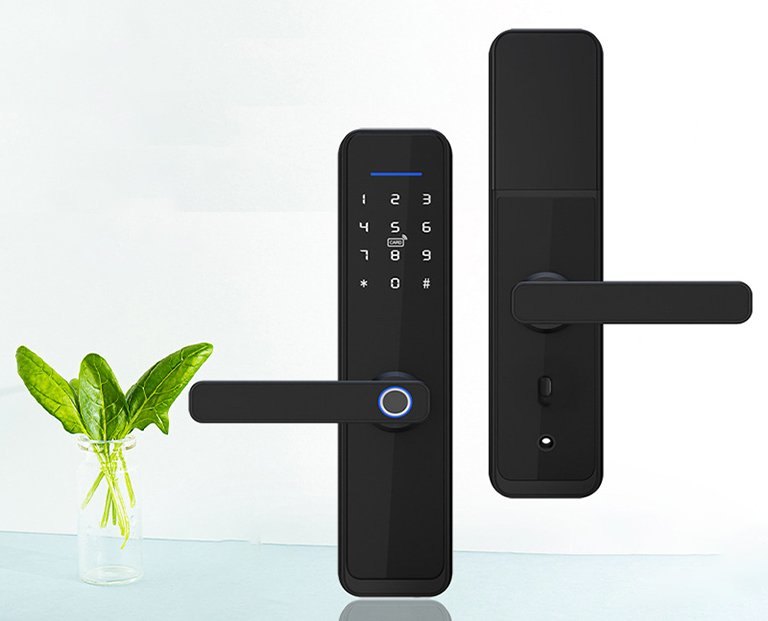
A smart lock is a mechanism with an electromagnet in it, and every solenoid decision follows from the bolt. Three kinematic families dominate: a sliding bolt that must travel its full stroke against spring preload to reach the locked or unlocked position; a rotating cam driven part-way by the solenoid and part-way by the user's thumb-turn; and a motor-driven deadbolt where the solenoid only blocks or releases the motor path. They need different strokes, forces and duty profiles — a sliding bolt wants 5–10 mm of travel, a cam release wants a short, fast 2–3 mm step, and a motor-block application usually wants a small latching part that holds position with zero current.
Measure the worst-case mechanical clearance on your strike plate, not the nominal. Tolerance stack between the bolt, the strike and the door gap eats 1–2 mm before the solenoid ever sees a load.
Stroke and force at the working gap
The force that matters is the force at the end of the stroke, when the bolt has to seat against spring preload and friction — not the holding force at the closed gap. On a 6 mm stroke application this distinction routinely costs one frame size when it is discovered late, and zero frames when it is discovered early. Ask each supplier for force at your stroke; a datasheet that only quotes closed-gap holding force is withholding the number you need. The force-vs-stroke guide explains why the two numbers differ by a factor of two or three on the same part.
Latching or spring-return: the battery decides
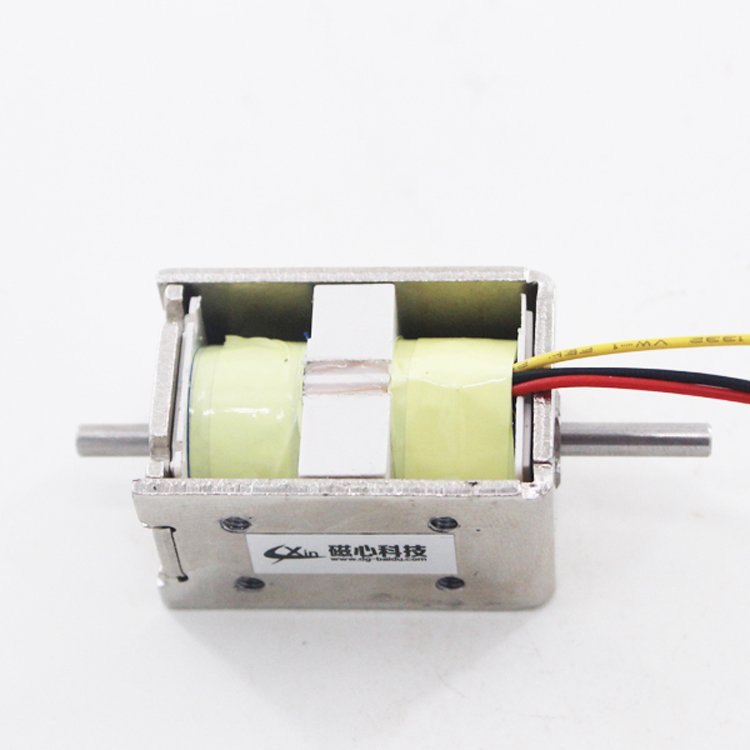
Every smart lock runs on a battery, and the battery budget splits the field in two. A spring-return solenoid must stay energised for as long as the state is held — minutes for a door left open, which no coin cell tolerates. A latching solenoid holds its position with a permanent magnet after a short pulse: holding current is zero, and the energy per operation is just the pulse. For battery locks the latching construction is the default answer, with a mechanical bias doing the return where the mechanism allows it. The trade-offs are compared in detail in the latching vs spring-return guide.
The battery budget, in numbers
Do the arithmetic before you fall in love with a coil. A 12 V, 5.76 W latching coil draws about 0.5 A; over a 100 ms pulse that is roughly 50 mC per operation — a thousand operations on a 1000 µF capacitor's charge, trivially recharged between uses. Compare a spring-return part at the same wattage held open for 10 minutes: 9,600 times the energy per operation. The design consequences follow: size the driver for the cold-coil inrush, put the capacitor at the coil terminals, and check the driver's off-state leakage — on a part that spends 99 % of its life asleep, 1 mA of leakage costs more battery than every pulse combined. The low-power solenoid page works this arithmetic across the range.
Noise: the spec that returns the samples
Locks live next to people's ears. The click of a solenoid seating is dominated by the impact at the end of travel, and it is designed, not inherited: a resilient stop, a damped plunger and a spring rate matched to the coil reduce audible noise at the cost of a little stroke and a few milliseconds. Our car door lock actuator case is the reference point — under 50 dB at −40 °C after a thermal soak, over 100,000 units. Cold matters: a lock tested at room temperature will click differently on a winter morning, and the coil's force drops as it heats while the spring does not. Specify the noise limit at both temperature extremes.
Validation before tooling
Three tests separate a working lock design from a recalled one. First, cycle life at the real load — the bolt, spring and solenoid as an assembly, not a bare solenoid on a bench; a number without load and stroke stated is marketing. Second, thermal: force at minimum battery voltage after the worst-case temperature soak, because the mechanism must work on the last percent of charge. Third, shock: a slammed door loads the bolt several times the static force, so the holding or latching force must be two to three times the calculated shock load. The smart lock application page lists the full validation set we run with lock customers, and the latching family page is the usual starting frame set for the designs above.
Frequently asked questions
What solenoid do I need for an electronic door lock?
Most battery locks use a 12 V latching solenoid: 3–8 mm of stroke depending on the bolt kinematics, holding force two to three times the calculated shock load, and zero holding current so the battery only supplies the pulse. Send the bolt travel and preload for a frame recommendation.
How much force does a smart lock solenoid need?
Enough to move the bolt against spring preload and friction at the end of the stroke — typically 5–40 N at the working gap for cabinet and door locks. The closed-gap headline force will be higher; specify the force at your stroke instead.
Why does my lock solenoid get warm?
Because it is energised longer than its duty-cycle rating. If the mechanism needs a held state, use a latching type that holds magnetically with zero current, or re-specify the coil at the actual ON time.
Can one solenoid both lock and unlock a door?
A bi-stable latching solenoid can, by reversing the pulse polarity; a spring-return part can only do one direction electrically. Most lock designs let a spring or the user do the return and let the solenoid do one decisive move.
Related reading
- Top 10 Solenoid Manufacturers in China — How Buyers Actually Build the List11 min
- Custom Solenoid vs Standard Solenoid: Which Is Better?10 min
- How to Choose a Solenoid for Parcel Lockers10 min
- Inside a Chinese Solenoid Factory: Capabilities and Quality Control to Verify11 min
- How to Select a Push-Pull Solenoid9 min
- How to Select a Solenoid for Your Application10 min
- Solenoid Force vs. Stroke Explained9 min
- Solenoid Duty Cycle and Maximum On-Time9 min
- Latching vs. Spring-Return Solenoids8 min