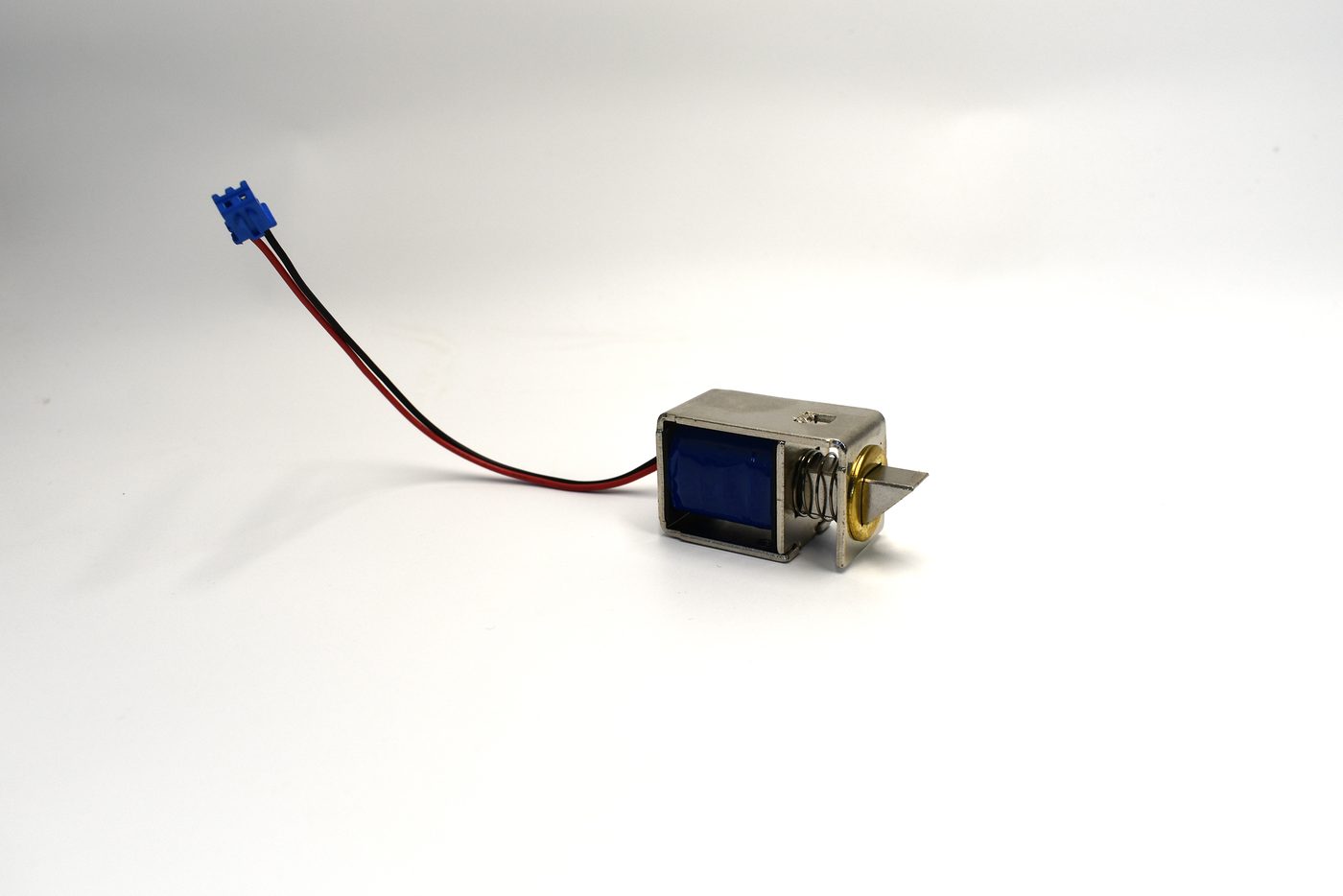
Twelve volts is the default rail in access control, automotive body systems and battery-backed equipment, so most push-pull enquiries arrive with the voltage already decided. That removes one variable and leaves three that matter more: the stroke the mechanism needs, the force available at the end of that stroke, and the duty cycle the coil has to survive.
A 12 V winding is a winding choice, not a property of the frame. The same U0835 or U1253 body can be supplied for 6 V, 12 V or 24 V; the wire gauge and turn count change, and with them the current, the wattage and the temperature rise. The models below leave the factory with a 12 V winding as standard. Anything else on these frames is a winding change rather than a new design.
What this specification changes
Force belongs to a stroke
A catalogue figure of 30 N means 30 N at a stated air gap, usually the closed position. At 8 mm open the same part may hold a third of that. Ask for the force at the stroke you actually use, or for the force-stroke curve.
Inrush is not holding current
A cold coil draws more current than a warm one, and a coil switched through a relay sees a short inrush before the armature settles. Size the driver for the cold-coil current, not the steady-state figure.
Heat sets the duty cycle
Two parts with the same 12 V winding can carry different wattage. The U1253L/S runs 3.6 W continuously or 36 W at 10 % ED — ten times the force for a tenth of the time, at the same final coil temperature.
The return path is part of the spec
Push or pull is a function of the plunger end and the stop, not of polarity. State which direction the load moves and whether a spring brings it back; a part built to push will not pull a latch open.
Models that meet this specification
| Model | Construction | Stroke | Force | Voltage |
|---|---|---|---|---|
| U0835L-12C13 | Rectangular Push-Pull Solenoid | up to 8 mm | up to 30 N | 12 V DC |
| U0876 | Automotive Push-Pull Solenoid | 6 mm | up to 8 N | 12 V DC |
| U1253L/S | Compact Open-Frame Push-Pull Solenoid | up to 10 mm (curve range) | on drawing | Custom at order (typ. 12 / 24 V DC) |
| U0834L/S | Open-frame U0834L/S | — | on drawing | to order |
Values are catalogue figures at the stated duty cycle. The force that matters is the force at your working gap — request the curve for the model you shortlist.
Where this specification is used
Questions buyers ask
Can I run a 24 V solenoid on 12 V?
Not usefully. Coil power falls roughly with the square of the voltage, so a 24 V part on 12 V produces about a quarter of its rated wattage — and much less than a quarter of its force at the working gap. The correct fix is a 12 V winding on the same frame.
What current does a 12 V push-pull solenoid draw?
Divide the coil wattage by twelve. A 12 W coil draws about 1 A when cold; the 3.6 W continuous winding of the U1253L/S draws about 0.3 A. Resistance rises as the coil heats, so the warm current is lower than the cold figure.
Can one part both push and pull?
The L/S suffix means the same frame is built as a pull version or a push version. Direction is set mechanically by the plunger end and the stop, not by reversing the wires — unless the part is a bipolar latching type.
Is a sealed 12 V version available?
Yes. The U0876 is sealed to IP54 for automotive and outdoor equipment. Other frames can be sealed or encapsulated to order, although sealing reduces heat dissipation and therefore the continuous wattage.