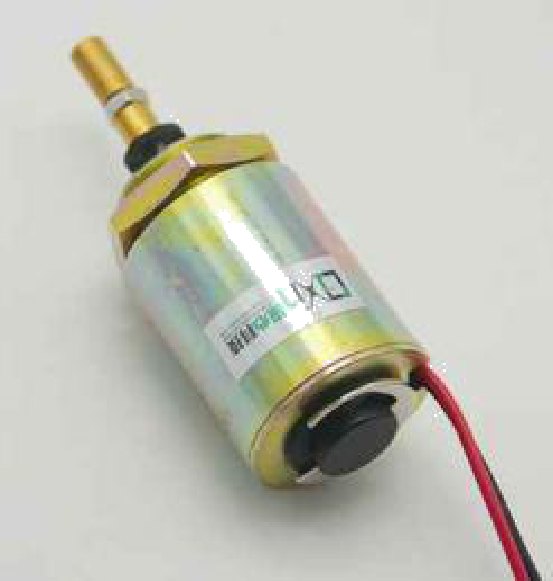
A tubular solenoid wraps the magnetic circuit around the coil in a cylindrical housing and runs the plunger inside a bore. The closed flux path gives the highest force per unit volume of the standard constructions, and the bore keeps the working gap radial so force stays predictable across the travel.
The range here runs from 9 mm miniature bodies to 64 mm frames rated 500 N at the working gap, with front-flange or threaded-body mounting and windings from 5 to 48 V DC. Mounting distorts a thin wall if clamped hard - use a clamp band on a reinforced section or pot the part in.
What this specification changes
Force density is the point
The closed magnetic circuit concentrates flux where it works, which is why a 64 mm tubular part reaches 500 N where an open frame of the same size stops far lower.
The bore guides the plunger
Side load tolerance is better than an open frame, but a long plunger is still a cantilever - guide the load for strokes past 25 mm.
Mounting changes the rating
Clamping a thin-walled tube out of round adds friction; potting changes the thermal path. Both belong in the enquiry, not in the field failure.
Models that meet this specification
| Model | Construction | Stroke | Force | Voltage |
|---|---|---|---|---|
| T0925L/S | Tubular T0925L/S | — | on drawing | to order |
| T2530L/S | 25 mm Tubular Solenoid, 30 mm Body | 0–12 mm (curve range) | on drawing | to order |
| T1540L/S | 15 mm Tubular Solenoid, 40 mm Body | 0–10 mm (curve range) | on drawing | to order |
| T6490L/S | 64 mm Tubular Solenoid, 90 mm Body | 0–12 mm (curve range) | on drawing | to order |
Values are catalogue figures at the stated duty cycle. The force that matters is the force at your working gap — request the curve for the model you shortlist.
Where this specification is used
Questions buyers ask
What is a tubular solenoid?
A solenoid with a cylindrical housing that closes the flux path around the coil and guides the plunger in a bore - the standard choice for longer strokes and high force density.
Tubular or open-frame solenoid?
Tubular for longer strokes, higher force per volume and a guided plunger; open-frame for cost, heat dissipation and simple flange mounting at short strokes.
Can tubular solenoids be sealed?
Yes, by potting or sealing, at some continuous-wattage cost on small frames. State the environment at enquiry so the coil is rated for it.