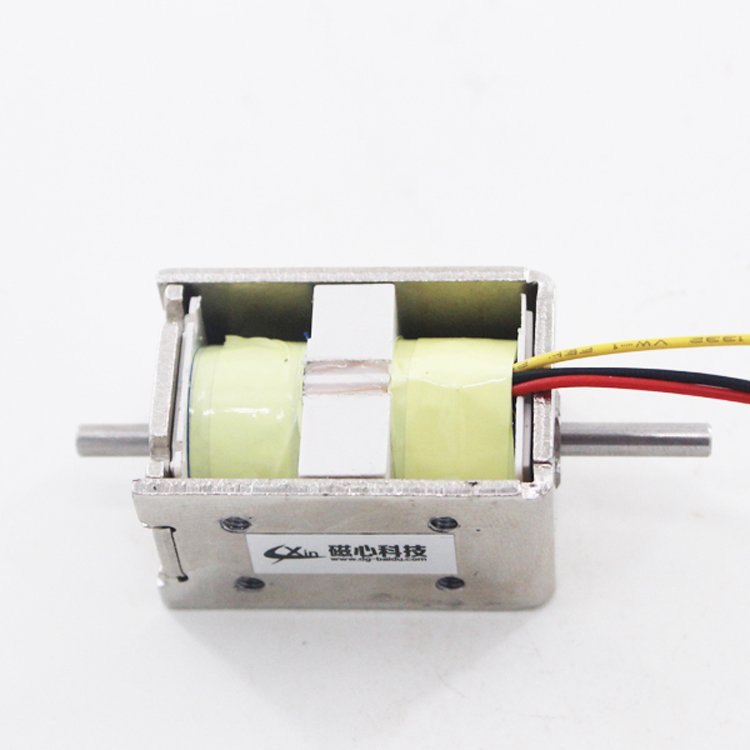
A bistable solenoid has two stable states, held by a permanent magnet rather than by the coil. A short pulse moves the plunger from one to the other; between pulses the coil is off and the holding current is zero. Energy per operation is pulse energy only - which is why every battery-powered lock, meter and valve that holds a state for minutes or hours ends up with a bistable part.
Two drive schemes exist. A true bi-directional part reverses the pulse polarity between set and reset (H-bridge or two relays); a polarity-symmetric part with a mechanical bias uses one pulse direction and lets the spring return. The drive decision belongs before the part decision - it changes the coil and the circuit.
What this specification changes
Reversal is a drive problem
A single low-side MOSFET cannot reverse polarity. If the design needs both states electrically, budget the H-bridge before choosing the coil.
The pulse is a charge, not a current
A 0.5 A coil over 100 ms is 50 mC - a 1000 uF capacitor supplies it and spares the battery a deep sag.
Shock sets the holding spec
A slammed door loads the latch several times the static force; specify two to three times the calculated shock load.
Models that meet this specification
| Model | Construction | Stroke | Force | Voltage |
|---|---|---|---|---|
| KS1139L/S | Bi-Directional Latching Solenoid | 5 mm curve range | 0.5 kgf | to order |
| KS1225L/S | Bi-stable latching KS1225L/S | — | 200 gf | to order |
| KS1564L/S | Bi-stable latching KS1564L/S | — | 1 k gf | to order |
| X40180 | Square Latching Solenoid | 4 mm | up to 40 N | 6 / 12 V DC |
Values are catalogue figures at the stated duty cycle. The force that matters is the force at your working gap — request the curve for the model you shortlist.
Where this specification is used
Questions buyers ask
What is a bistable solenoid?
A latching solenoid with two magnetically stable positions. A short pulse switches between them; between pulses it draws zero current.
Bistable or monostable solenoid?
Bistable when a state is held for minutes or longer on battery power; monostable (spring-return) when actuation is frequent, simple, and mains-powered.
How long can the pulse be?
Within the rated maximum ON time - typically 0.1-0.3 s on these frames. Longer pulses heat the coil without adding force.