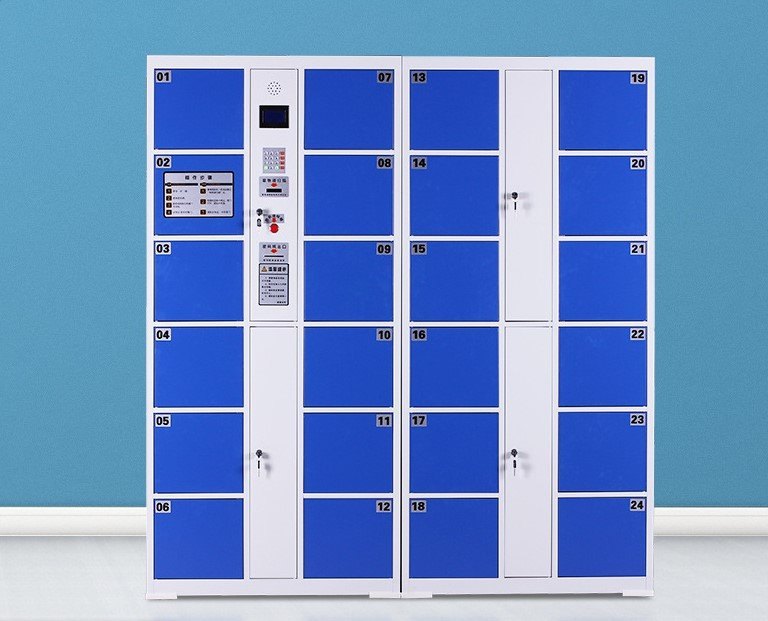
The duty profile of a locker bank
A parcel locker is not a door; it is a fleet. A 60-door cabinet sees each door opened a few times a day, but the cabinet as a whole cycles continuously from morning deliveries to evening collections, and the electronics sit on one shared battery or mains-backed rail. The specification that follows: each individual solenoid is pulse-duty — a 100–150 ms pulse per operation, seconds of nothing between — while the cabinet's power system must handle a superposition of doors. A latching construction with zero holding current keeps the per-door energy at pulse-only cost, which is why nearly every serious locker design uses one; the 12 V latching specification page lists the frames and their pulse data.
Fail position and mechanical override
Two decisions that must be explicit, because the wrong default is expensive. Fail position: an unattended locker must be fail-secure — locked without power — or a blackout opens every door in the cabinet. Mechanical override: couriers, service technicians and the occasional dead battery all need a way to open a door without electronics, and that override must work after years of dust and disuse. Plan the override as a lever or cam in the housing at design time; retrofitting one onto a finished cabinet means a new lock, and the solenoid cannot rescue a design that forgot it. Both points belong in the supplier conversation from the first message — the locker and vending application page lists the cabinet-level questions in full.
Holding force against slammed doors
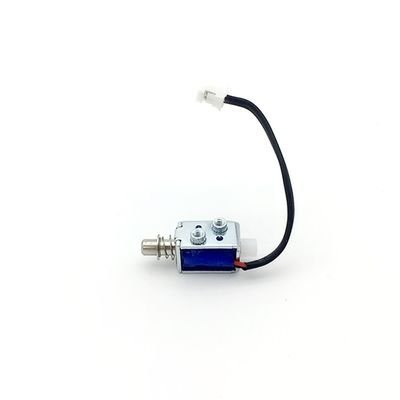
The static load on a locker bolt is small; the shock load is not. A slammed door transmits an impulse through the strike into the bolt several times larger than anything the courier's hand applied. Specify holding force at two to three times the calculated static load, and ask for the supplier's shock test — not the holding figure alone. For the bolt solenoid itself, the number that matters is pull force at the working gap during the pulse, which is always lower than the closed-gap holding figure; on the worked example below, the distinction set the frame choice.
Battery and signal wiring at cabinet scale
At cabinet scale the electrical design is a network problem. A door 30 cabinets away from the controller sees voltage drop in the harness before the coil sees anything, so the coil must pull in at the worst-case voltage at the far end — which is why most locker locks are wound for a wide 6–12 V window rather than a single nominal. Open-door feedback matters too: a reed switch or an optical signal confirming the bolt actually moved, because a courier who cannot tell a failed actuation from a full compartment will simply force the door. Both signals belong on the same connector as the coil, tested as an assembly.
A worked example: 8 mm bolt, 150 ms pulse
The full requirement set in practice: a battery-powered parcel locker needed an 8 mm bolt throw driven on a 150 ms pulse from a battery rail, with fail-secure behaviour and a mechanical override. The build and its numbers — including what was modified from a standard frame and what was not — are documented in the parcel locker case study. The point of the case is not the specific part; it is that every number in it came from the cabinet and the courier's day, not from the solenoid catalogue.
Questions to put to every supplier
- Pulse data at the far-end voltage, not just the nominal rail.
- Cycle-test report with your bolt load and stroke stated.
- Shock figure for the holding force against a slammed door.
- The mechanical override design — shown, not promised.
- Open-feedback options on the same connector as the coil.
- Whether the lock ships as a tested assembly or a solenoid you integrate yourself.
A supplier who answers those six with documents is ready for a cabinet project. If the comparison reaches us, the solenoid lock family and the requirements page are the entry points — bring the cabinet, not just the lock.
Frequently asked questions
What solenoid does a parcel locker lock need?
Typically a 12 V latching solenoid with 5–10 mm of bolt travel, pulse-driven for 100–150 ms, holding force two to three times the static bolt load to survive slammed doors, plus a mechanical override for power failure. The frame choice depends on the bolt kinematics.
Should a locker lock be fail-secure or fail-safe?
Fail-secure — locked without power — for unattended cabinets, so a blackout does not open every compartment. Fail-safe is for fire-egress doors, not parcel lockers.
How many cycles can a locker lock solenoid last?
Hundreds of thousands of cycles when the bolt is not side-loaded and the pulse stays within rating. Ask for the cycle-test report with your load and stroke stated — a number without conditions is not a specification.
Can one solenoid serve many locker doors?
No — each door needs its own lock mechanism. The cabinet shares power and control electronics, not the actuator: one coil per door, pulse-driven from the shared rail.
Related reading
- Top 10 Solenoid Manufacturers in China — How Buyers Actually Build the List11 min
- Custom Solenoid vs Standard Solenoid: Which Is Better?10 min
- Solenoid for Smart Lock: Design and Selection Guide12 min
- Inside a Chinese Solenoid Factory: Capabilities and Quality Control to Verify11 min
- How to Select a Push-Pull Solenoid9 min
- How to Select a Solenoid for Your Application10 min
- Solenoid Force vs. Stroke Explained9 min
- Solenoid Duty Cycle and Maximum On-Time9 min
- Latching vs. Spring-Return Solenoids8 min